
When I started in aviation, I owned one aircraft. To buy the second, I went to a bank. The conversation was not pleasant. They wanted a heavy rate, a personal guarantee, and a thick stack of paper. To them I was a man with an idea and a single plane, and ideas default. So I paid the rate they asked. That was the price of the doubt.
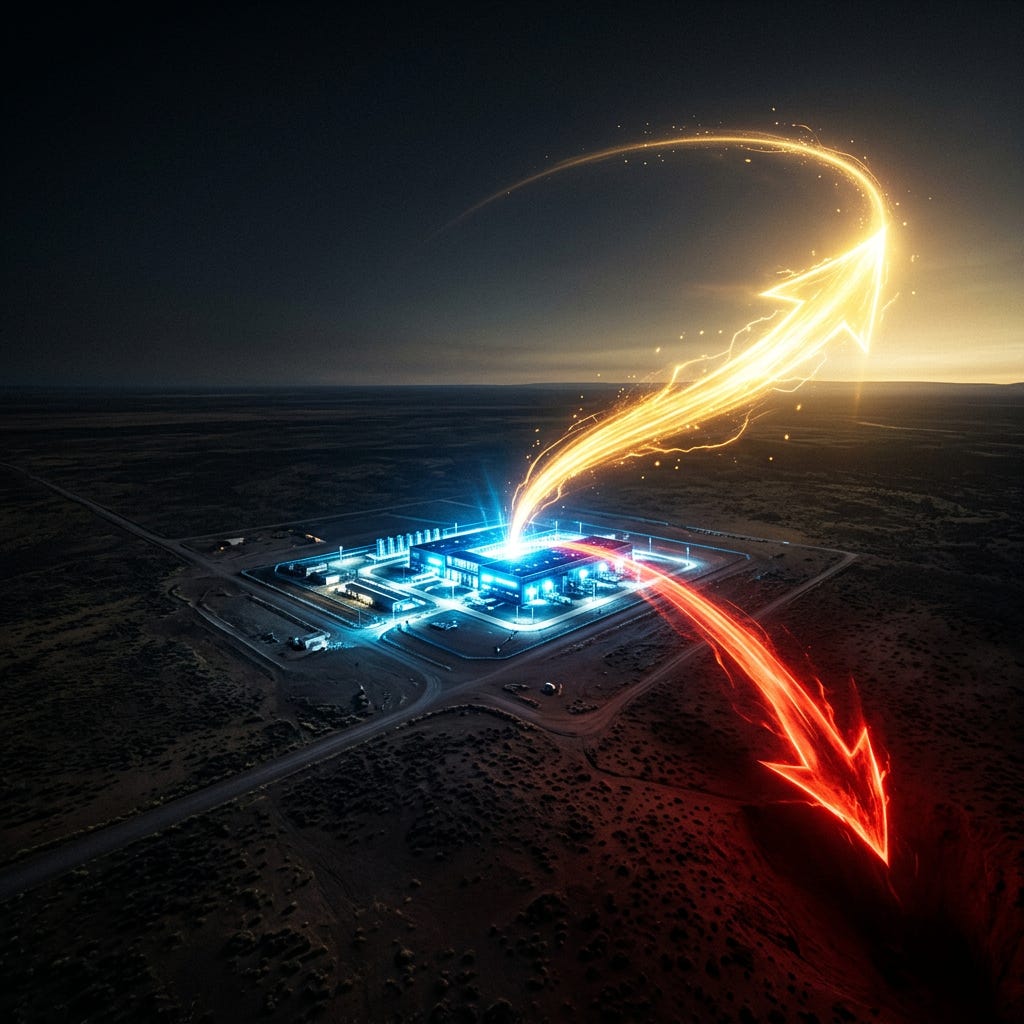
A few years later I owned dozens of aircraft. The lease payments had come in, month after month, like clockwork. And the banks that once made me beg were now calling me. The rate had fallen by a third. The guarantees softened. The paper thinned. Nothing about the planes had changed. A plane is a plane. What changed was their belief about whether the money would show up. Once they had watched the cash arrive enough times, the fear drained out of the price.
That is the most important thing I ever learned about capital. The thing you own does not have to change for its value to change. The cost of financing it can change instead. And when a careful lender, a man who only ever stands to lose, decides you are safer than he thought, the value of what you own moves a great deal, quietly, while the object itself sits unchanged in the hangar.
I am telling you this because it is happening right now in the corner of the market I know best, and the stock market has not looked up.
In November, Applied Digital raised money to build a data centre leased to CoreWeave. The market demanded roughly 11 percent, all in, to fund it. That was the price of the risk. This week, the same company came back to borrow against the fourth building in the same program, leased to the same tenant. The market demanded 7 percent. The order book was five times larger than the deal. Nothing about the building changed. Nothing about the tenant changed. The fear simply drained out of the price, exactly the way it once drained out of mine.
And while that was unfolding in the bond market, the stock market was doing the opposite. Shares in AI infrastructure owners have been falling. The narrative says the boom is fragile. The narrative says the spending is reckless. The narrative says the bust is coming. Two markets are pricing the same assets right now, and they have reached opposite conclusions. This letter is about why that gap exists, and why I trust one of these markets far more than the other.
The Toll and the Bridge
The value of an asset that collects a fee comes down to two things. How much the fee is, and what it costs to finance the thing that collects it. Most of the time, one moves in your favour while the other moves against you. Rents rise, but borrowing gets expensive. Borrowing gets cheap, but rents stall. The rare and valuable moment is when both move in your favour at once.
Warren Buffett spent a career describing the business he wanted to own, and he kept returning to one image. The toll bridge. An asset that sits in a necessary place, collects a fee from everyone who needs to cross, and can raise that fee over time without losing the traffic. He liked toll bridges because the demand was not optional and the pricing was not fragile.
The owners of AI compute infrastructure are sitting on a version of the toll bridge. The bridge is the rack space, the power, the cooling, the interconnection. The toll is the rental rate on the machines that sit inside it. Right now both the toll and the cost of building the bridge are moving in the owner’s favour at the same time. The toll is rising. The financing is getting cheaper. The stock market has noticed neither.
Let me take each in turn.
The Tenants Will Not Let Go
A few weeks ago I showed you compute rental prices going vertical. That was the revenue side of this business. The data since then has not softened. It has firmed.
The most telling detail is not the level of prices. It is what tenants are doing with the capacity they already hold. On the older Hopper generation, on demand availability is simply gone. Sold out. And the tenants who hold those nodes are not releasing them back into the rental pool when their own usage dips. They are holding them and paying as much as 2.90 dollars an hour to keep them, rather than letting anyone else have them. When the people who already own the scarce thing refuse to give it up at a higher price, you are not looking at soft demand. You are looking at hoarding.
Look at where the contracts are being signed. Buyers are reaching back to older silicon and locking it up for years. Two year and three year contracts on the prior generation are being signed at firm rates, around 2.05 dollars per GPU hour at two years and 1.80 dollars at three. Even two generations back, rental prices have risen sharply, with some of the oldest cards seeing increases of 60 to 80 percent. Clients are bidding up the long end of the curve harder than the short end. That is the behaviour of buyers who expect scarcity to persist, not pass. Nobody signs a three year lease on a depreciating machine because they think the shortage ends next quarter. And prepay requirements are climbing alongside the rates, which means owners are now collecting more cash upfront before the first hour is ever served.
The cost to build new capacity is rising at the same time. The servers that house the current generation chips have moved from the low 300,000 dollar range to roughly 390,000 dollars for one tier and toward 450,000 dollars for the next, with some quotes running far higher. The driver is memory. Server memory has risen close to 490 percent year over year. The mobile variant has risen around 370 percent. These are not typographical errors. The components that go inside the machines have repriced violently upward.
Here is why that matters, and it is the part the market consistently misreads. Rising input costs do not hurt the people who already own finished, energised, occupied capacity. They hurt the people trying to build new capacity to compete with them. Every increase in the cost of memory, servers, and construction raises the price at which a new entrant must rent in order to earn a return. It raises the floor under the incumbent’s pricing and widens the moat around the incumbent’s assets. The marginal builder gets punished. The owner of the finished asset gets entrenched. Scarcity in the inputs is not a headwind for the incumbent. It is a gift.
That is the toll, and it is rising.
The Banks Stopped Being Afraid
Now the second force. It is quieter than the first. It may matter more.
While the rental market tightens, the cost of financing this infrastructure is collapsing. Not drifting lower. Collapsing.
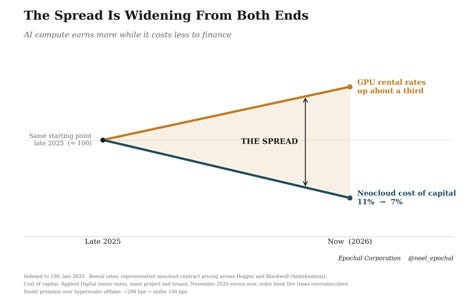
Return to the Applied Digital deal. In November, the market funded one of these buildings leased to CoreWeave at roughly 11 percent. This week it funded the next one at 7 percent, and the order book was oversubscribed five times over. That is not a small repricing. Over the life of a large facility, the difference between 11 percent money and 7 percent money is the difference between a project that barely clears its hurdle and one that throws off substantial free cash flow to its owner.
There is a name worth giving to the gap I am describing. Call it the doubt premium. It is the extra yield a lender demands to fund a building leased to a neocloud rather than one leased straight to a hyperscaler like Google or Amazon. It is the price of not being sure the tenant will still be there in five years. When a lender begins to trust CoreWeave the way it trusts Amazon, the doubt premium falls toward zero, and the cost of building the bridge falls with it. In November the doubt premium on this kind of paper ran around 290 basis points. This week, on a comparable deal, it was inside 100. The market is not merely charging less for the risk. It has decided the risk was smaller than it feared.
Read that slowly. The credit market has cut by roughly two thirds the extra compensation it demands to lend against a neocloud backed cash flow rather than a hyperscaler backed one. In real money, it is beginning to treat a CoreWeave lease as something close to a hyperscaler lease. The perceived fragility of the entire neocloud business model, the very thing the equity market is busy selling, is being quietly erased in the one market that has to be right about cash flows. And there is more coming. CoreWeave itself has a 3.5 billion dollar senior notes deal in the market as I write this. The appetite from the first wave suggests it will be met with demand, not resistance.
Let me put numbers on the table, because a thesis you cannot check is just a story. I expect the CoreWeave senior notes now in the market to come oversubscribed by at least two times, and to price at or inside 7 percent. I expect the doubt premium to keep compressing through the rest of 2026 and into 2027, toward 50 basis points. And I expect the gap between what the credit market believes and what the equity market is paying to close within six to twelve months, with the equity moving toward the cash flows rather than the other way around. Write these down. If I am wrong, hold me to it. If I am right, remember which market told you first.
Consider what a move like this does to value. The worth of any asset is the cash it will produce, discounted back at the cost of capital. Lower that discount rate from 11 percent to 7 percent and the present value of a long stream of income rises substantially, often by a third or more. The building is unchanged. The leases are unchanged. The capital market alone has revalued it. And because the equity owner sits on top of the debt, the gain to the equity is larger still.
I want to be clear about why I weight this so heavily. The bond market and the stock market are not two opinions of equal quality. They occupy different seats in the capital structure, and those seats produce different incentives. A bondholder gets paid before an equity holder. A bondholder has no upside beyond the coupon. All a bondholder can do is lose. That asymmetry makes credit investors the most conservative underwriters in finance. They do not get paid to dream. They get paid to be right about whether the cash shows up. When that crowd, the crowd with everything to lose and nothing to gain, lines up five deep to fund an asset at a falling yield, they are telling you something the equity market has not yet admitted. They have read the leases, the tenants, and the cash flows, and they have concluded the risk is lower than they believed a few months ago.
That is the cost of building the bridge, and it is falling.
Cheap Money Is a Weapon
It would be enough if these two forces were merely happening at the same time by coincidence. They are not a coincidence. They feed each other.
Start with the prepay. As tenants put more cash down upfront, the owner finances less of each project with debt. Less debt means lower default risk. Lower default risk means cheaper debt on the next deal. The rising toll is, by itself, lowering the cost of the capital.
Now run it forward. Cheaper capital is not a passive benefit. It is a weapon. The owner who can raise money at 7 percent can outbid the owner stuck at 11 percent for the scarce inputs that gate this entire industry. Power. Land. Interconnection. Equipment with lead times that stretch past the horizon. The cheaper your capital, the more projects clear your hurdle rate, and the more of the scarce supply you can lock up before anyone else reaches it. Scale then lowers your unit costs through procurement and operating density, which improves your economics, which lowers your cost of capital again.
This is a flywheel. Rising rents lower the cost of capital. A lower cost of capital lets the strongest owners build and buy more. More scale produces better economics and a longer record of contracts that get paid. A better record lowers the cost of capital further still. The lead does not hold steady. It compounds. And it compounds in favour of whoever already owns the finished, financed, occupied asset, while the marginal builder watches the gap widen from the wrong side of it.
The Only Equation That Matters
Put the two forces together and you arrive at the only equation that matters in capital intensive investing.
The value of an asset is its future cash flow divided by the cost of the capital that funds it. The return the asset earns sits in the numerator. The cost of capital sits in the denominator. When the numerator rises, the asset is worth more. When the denominator falls, the asset is worth more. When both happen at once, the value does not add. It compounds.
That is exactly what is happening. The return on these assets is rising, because rental rates are firming and the margin on every repriced contract is expanding. The cost of capital is falling, because the credit market has repriced the risk. The spread between what these assets earn and what they cost to finance is widening from both directions at the same time. And the equity that sits on top of that spread, the residual claim after the debt is served, moves more than either force alone, because that is what residual claims do.
Charlie Munger had a remedy for the temptation to overcomplicate this. He spent his life trying, in his words, to be consistently not stupid rather than brilliant. The not stupid observation here is almost embarrassingly simple. If an asset earns more and costs less to fund, and you can buy the equity on top of it while the crowd is selling, you do not need a sophisticated model to know what to do. You need the discipline to act on something this plain while everyone around you is looking the other way.
If you are finding value in the way I think about the physical layer of artificial intelligence, the power, the silicon, and now the capital that funds them, consider subscribing. I write these letters for investors who would rather understand the machinery than chase the headline.
One of Them Is Wrong
The bond market is buying what the stock market is selling. Only one of them studies the downside for a living.
They are looking at the same buildings, the same leases, the same tenants, and they have reached opposite verdicts. One of them is wrong.
History is not kind to the idea that equity is the smarter of the two in moments like this. The stock market trades on sentiment, on the daily mood, on the story being told that week. It is a voting machine in the short run, as Benjamin Graham taught, and votes are cheap. The bond market is slower, more cynical, and more careful, because the people in it have studied the downside until they can recite it in their sleep. When the two disagree this sharply, the resolution usually arrives by the equity market catching up to what the credit market already understood, not the other way around.
I have watched the physical economy and the financial economy drift apart before. Sentiment leads price for a season. Fundamentals lead price for a cycle. The two always reconcile in the end, and the reconciliation tends to be swift and uncomfortable for whoever was standing on the wrong side of it. Right now the wrong side is the one selling assets whose cash flows are rising and whose financing is getting cheaper, on the theory that something must be wrong because the price is falling. That is not analysis. That is the price telling people what to think, which is the oldest mistake in the business.
Where the Bridge Could Crack
None of this means the assets are without risk, and I would not respect you if I pretended otherwise.
The real risk in this corner of the market is not demand. Demand has been answered by sold out capacity and tenants who will not give their nodes back. The real risk is concentration. A great deal of neocloud cash flow leans on a small number of tenants, and a meaningful slice of it leans on CoreWeave in particular. If that counterparty stumbles, the leases that look so safe today would be tested in a hurry. The bond market is pricing that risk lower than it did in November. The bond market can also be wrong, and concentration is exactly the kind of risk that looks fine until the day it does not.
The machines depreciate. Silicon advances. A chip that commands a premium today will be ordinary in a few years, and the useful life of any single generation is shorter than the life of the building it sits in. Useful lives may prove shorter than the contracts assume. Regulation will shift. Power access, the thing that ultimately gates all of this, can be helped or hindered by policy that no spreadsheet controls.
These are real. I hold them in full view. But notice their character. They are engineering risks and counterparty risks, not demand risks. And engineering and counterparty risks are precisely the risks that favour the owner with the strongest balance sheet, the longest contracts, the most creditworthy tenants, and the physical assets that hold value beyond any single generation of chip. A toll bridge can crack. The answer is not to avoid toll bridges. The answer is to own the well built one, on the busy crossing, financed conservatively, and to know the difference.
Who Did the Homework
Step back from the noise and the picture is simple. The toll on the bridge is rising. The cost of building the bridge is falling. The two are feeding each other. The people whose job is to be right about cash flows are lining up to fund it, while the people whose job is to guess the mood are selling it. The spread between what these assets earn and what they cost to finance is widening from both ends at once, and that spread is where the value of the equity is made.
I do not know what the stock will do next quarter. I never have. But I know what the leases say, I know what the rental rates are doing, and I know what it means when the bond market cuts its required yield by a third and shows up five times oversubscribed. That is not a market that is afraid. That is a market that has done the work.
The equity market is pricing fear. The credit market is pricing the cash flows. I know which one does its homework.
Neel Khokhani
Founder and CEO, Epochal Corporation
@neel_epochal