
In January, a one-year contract on an H100 cleared at somewhere between $1.50 and $2.05 per GPU hour. In July, it cleared between $2.40 and $3.20. At the midpoint, that is a rise of roughly 58 percent in six months.
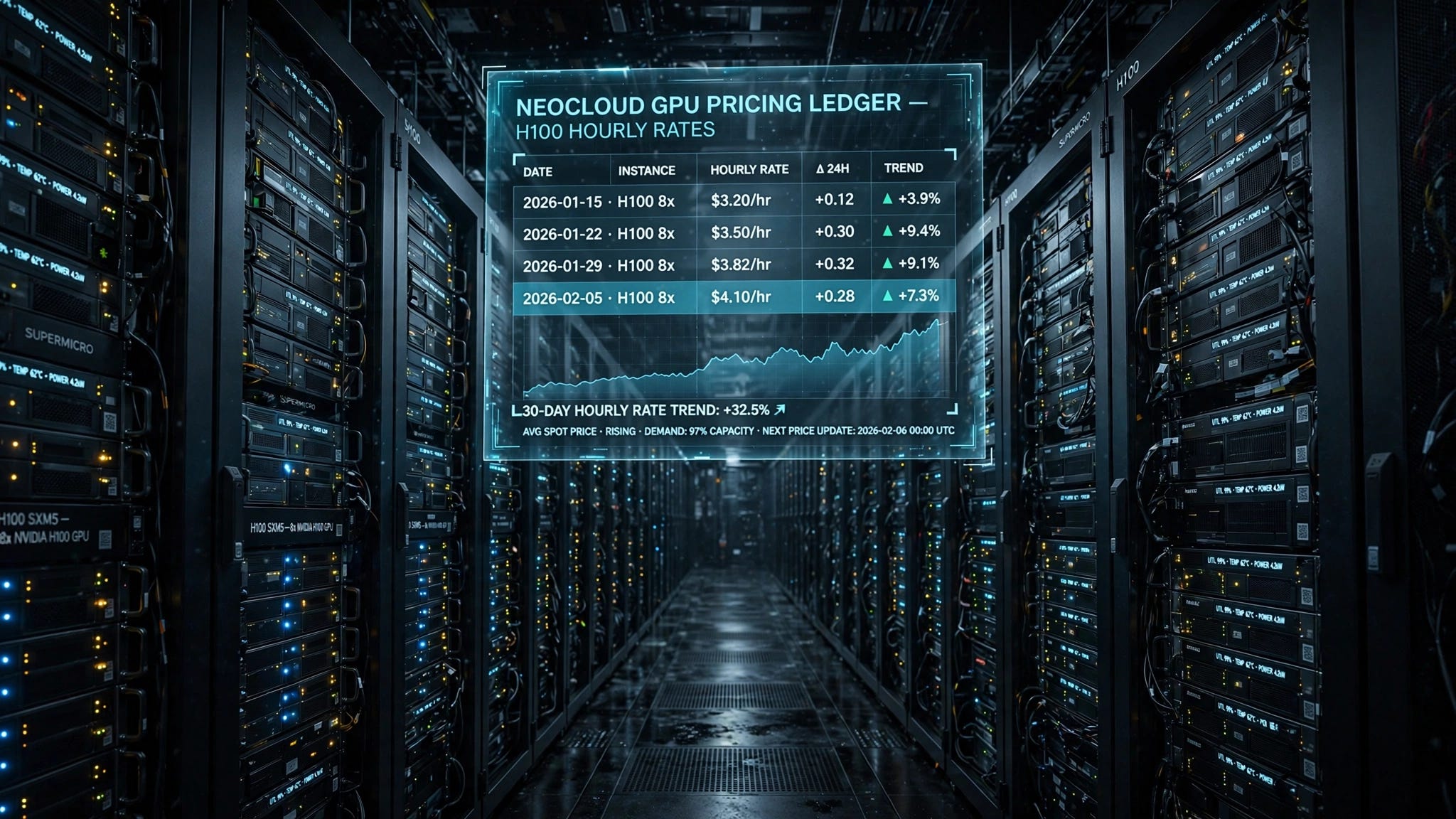
The H100 is not new. It is the workhorse of the 2023 buildout, two generations behind what Nvidia ships today. On a standard depreciation schedule, it is halfway through its accounting life and past its useful life for frontier training. It should be getting cheaper. Owners should be preparing to write it down.
Instead, the on-demand market for H100 capacity has been sold out in five of the last six months. The tenants holding nodes are refusing to release them back into the pool, and are paying above $2.70 an hour to keep them.
That single fact is the most useful thing I know about the neocloud market. The rest of this piece is arithmetic. Why it is true. What it is worth.
Six Months, Every Tenor, Every Vendor
The move was broad. Not one SKU in one market. Between January and July, contract pricing rose across every generation of accelerator being rented, including those meant to be on their way out.
Hopper led it. H100 one month rates moved from a $1.75 to $2.10 band to $2.90 to $3.30. H200 was stronger still: one year contracts went from roughly $2.03 at the midpoint to $3.45, an increase of about 70 percent. H200 on demand capacity has been sold out for six consecutive months, with existing tenants paying above $2.90 to hold what they have.
Blackwell moved in the same direction from a higher base. B200 three year contracts rose about 42 percent at the midpoint. B300 two year contracts rose about 39 percent. GB300 three year contracts went from roughly $3.58 to $5.00, and the five year from $3.10 to $4.60, a rise of 48 percent on the longest tenor quoted. B200, B300 and H200 on demand have each been marked sold out every month since February.
AMD, which is usually the release valve when Nvidia capacity is out of reach. This time it moved too. MI300 on-demand went from a $1.50 to $2.00 band in November to $2.50 to $2.70 in July. MI325 one-year contracts rose 63 percent over the same window. The substitution route is repricing as fast as the thing being substituted for. Of all, it is the strongest. In April, a five-year VR NVL72 contract indicated at $5.00 to $5.50. In July, it indicated at $7.50 to $8.00. That is a 48 percent increase in three months on hardware that is still ramping into volume shipment. A five-year commitment on Rubin now prices roughly 65 percent above a five-year commitment on GB300.
This is not a mix effect. It is not a survey artefact. It is a clearing price.
Hopper Is Now the Value Tier
The surprise is not Blackwell’s price. The surprise is Hopper.
GB300 has ramped. Rubin systems are shipping. By every roadmap from two years ago, H100 demand should be rolling off, with capacity cascading into cheap inference and then decommissioning. That is not what is happening. H100 capacity still sells out during the trading day in many markets. The on-demand pool has ceased to exist at any meaningful scale.
There are two reasons, and they compound.
The first is price. Blackwell and Rubin are now expensive enough that Hopper is the value tier, not the legacy tier. If a B300 one year contract costs $4.90 to $5.30 and an H100 costs $2.40 to $3.20, the H100 does not need to win on performance per watt. It needs to win on cost per useful token. For a growing share of inference workloads, it does.
The second is deeper. End demand for tokens is now strong enough to put a floor under every chip that can serve it. This is a structural change. In 2024, an accelerator’s rental value depended on its position at the frontier. In 2026, it depends on whether it can serve paying inference traffic at all. If yes, the chip earns. Ampere silicon is still earning. That was not true two years ago.
This is what the depreciation debate has been missing. The argument, whichThis is what the depreciation debate misses. The argument treats technological life and economic life as the same thing. They are not. A chip stops being competitive for frontier training long before it stops earning rent. Rent is what services the debt.ifferent industry, because it explains the mechanism better than any argument about compute.
In 2021, a semiconductor shortage cut new vehicle production. Three year old used cars appreciated. Some sold above their original sticker price. Nothing about those cars had improved. They had more kilometres on them and more wear than the year before. What changed was the production schedule for the thing that was supposed to replace them.
The residual value of an old asset is not primarily a function of the old The residual value of an old asset is not set by its condition. It is set by the new asset’s delivery date.ays it explicitly. The December 2026 forecast for H100 rental pricing was revised up 7.4 percent to $2.85 an hour in the space of under three weeks. More interestingly, the 2028 and 2029 forecasts were also revised up, and for reasons that have nothing to do with H100 demand.
Three things drove that. The July jump in observed prices. A reduction in training throughput from Rubin Ultra, where the previous configuration carried 26,250 dense FP8 petaflops and the current lighter configuration carries 17,500, a cut of about a third. And a reduction of roughly half in lifetime shipments of Google’s Humufish TPU v9, attributed to MediaTek as well as TSMC N2 delays. Mass production on that programme has slipped to the second half of 2027, with volume ramp in 2028.
Read those three together. Less compute arrives in 2028 and 2029 than the market assumed. The pool of available floating point operations shrinks. The price of compute that already exists and is energised goesThe forecast for a three year old chip went up because the future went down. The past repriced because the future shrank. dThat relationship runs both ways. It is the most important dynamic in this market. It is almost absent from how the sector is being valued.alued.
95 Percent Full Tells You Nothing
I operate a self storage business in the UAE. It has shown me something that translates directly, and I think more usefully than any technology analogy.
Occupancy is the first number you learn to watch and the least interesting one. Once you are above 95 percent, occupOccupancy is the first number you learn to watch and the least interesting. Above 95 percent, occupancy tells you nothing. It cannot go up much and it does not need to. Every dollar of value after that comes from one variable: the rate you achieve on the next unit that turns over, and the rate you push through to existing tenants at renewal. The building does not change. The concrete does not change. The rent roll changes.d has been sold out across four separate accelerator families for six straight months. Nothing further can be extracted from filling the building. Everything now comes from repricing it.
Here is what repricing looks like in arithmetic. Take a fleet of H100 capacity contracted at January rates, roughly $1.78 an hour at the midpoint, rolling into July rates of roughly $2.80. Assume an all in cash operating cost of around $0.80 per GPU hour covering power, cooling, colocation, networking, staff and overhead, before depreciation and interest. Cash contribution goes from $0.98 to $2.00 an hour. It doubles.
That assumption is illustrative and you should test it, but the conclusion is robust across a wide range. Put the cost base at $1.20 and contribution rises 178 percent. Put it at $0.50 and it rises 80 percent. A 58 percent move in price produces somewhere between an 80 and a 180 percent move in cash contribution, depending on where you think the operating costs sit.
That is the operating leThat is operating leverage in a rental business with a fixed cost base and a variable price. It is why the marginal repricing of an existing fleet matters more than the announcement of a new one.ber in the July data that makes the same point in a different way. The RTX 6000 Pro server is modelled at roughly $120,000, with an all in cluster cost of about $136,000 per server. Assume eight GPUs to a server and you have around $17,000 of capital per GPU. In January, a three year contract on that card indicated at $0.90 an hour at the midpoint. In July it indicated at $1.20. At 90 percent utilisation across a three year term, that difference is roughly $7,100 of additional contracted revenue per GPU.
Six months of price moveSix months of price movement added contracted revenue equal to more than 40 percent of the asset’s capital cost. The asset did not change.ou, consider subscribing. I write about the physical infrastructure layer of the AI buildout, and I try to publish the arithmetic rather than the conclusions.
25 Percent Up Front, Sometimes All of It
The rate move is the income statement story. The contract structure is the balance sheet story. The second matters more.
Prepayment of 25 percent or more is now the market standard. In some cases it reaches 50 percent. In rare cases, 100 percent. This is not a customer courtesy. It is the visible end of a chain that starts upstream.
OEMs are now asking neoclouds for 90 day deposits before delivery. That gives the OEM a better cash profile and removes the risk of holding expensive inventory without a committed buyer. The neocloud, in turn, does not typically sign a purchase order with the OEM until it has a signed customer contract in hand. So the 10 to 12 week lead time clock only starts once the customer commits, and any slippage upstream flows directly through to the customer’s delivery date.
In a balanced market, the customer would price that risk with late delivery penalties. In this market, that leverage does not exist. The alternative to accepting the terms is losing the allocation to the next bidder. The customer prepays a quarter of the contract value or more, absorbs the opportunity cost of every week of delay, and has limited recourse.
Think about what that does to a neocloud’s funding profiA capital intensive business that would ordinarily fund the full asset cost up front, carry it through construction and commissioning, and only then begin collecting, is instead collecting a quarter of the contract value before the hardware is ordered. The customer is providing a slice of the working capital. Deployment risk has been transferred to the party least able to price it.l, and it does not show up in a revenue line or a backlog headline. It shows up in how much external financing the operator needs and at what price. In a sector where the bear case is almost entirely about leverage and funding, this is the variable that matters most and gets discussed least.
There is a second structural signal in the term pricing that points the same way. In January, a three year GB300 contract priced about 13 percent above a five year. By July that discount for duration had narrowed to about 8 percent. B200 shows the same compression, from roughly 12 percent to roughly 9 percent. Operators are giving away less to secure long dated commitments.
In dry bulk shipping, when time charter rates converge toward spot, it tells you owners have stopped discounting duration because they no longer fear the downturn. Something similar is happening here. Long dIn dry bulk shipping, when time charter rates converge toward spot, owners have stopped discounting duration. They no longer fear the downturn. Something similar is happening here. Long duration revenue used to be something an operator paid for with a price concession. It was the only defence against a soft market. It is becoming something they can charge close to full rate for. For a business financing long lived assets, narrowing that duration gap between the asset and the contract is worth more than a headline number on a single quarter’s bookings.e targeted for the second half of 2026. Contract pricing has already moved 48 percent since April on the five year tenor, and the three year is now quoted at $8.20 to $8.50 per GPU hour.
There is a physical reason this capacity is scarce beyond the silicon itself. A VR200 NVL72 rack draws roughly 190 to 230 kilowatts, against 120 to 130 for Blackwell and around 40 for a Hopper rack. Rubin Ultra in the Kyber rack is specified at approximately 600 kilowatts for 2027. This is not a chip refresh. It is a redesign of power delivery and cooling, requiring 800-volt DC distribution and all liquid cooling.
Meanwhile, average rack density across the industry moved from about 16 kilowatts in 2025 to about 27 kilowatts in 2026, and only around one in five operators reports being ready to support the 50 to 70 kilowatt racks already common in AI deployments. Interconnection queues in major US markets run four to seven years. Roughly 2,300 gigawatts of generation and storage sits in US queues.
So a site that already has power, already has liquid cooling, and already has a tenant is definitely a good asset. It is close to unreplicable within the investment horizon of anyone trying to compete with it. And a site that has power but cannot support a 200 kilowatt rack is now a Hopper and Blackwell site by physics, which is another reason the older silicon is bid.
The Circularity I Cannot Argue Away
A thesis that only accommodates good news is not a thesis.
The counterparties are not uniformly investment grade. Some of the demand at the margin comes from AI labs that are themselves loss making and funded by equity raised on the strength of the same narrative which is driving these rental rates. Some of it is supported by vendor financing. There is circularity in this system, and it deserves to be named rather than explained away.
The prepayment structure that improves the operator’s funding profile also concentrates risk. If a large customer fails, the operator does not just lose future revenue. It loses a contract it has already ordered hardware against, in a market where that hardware was purchased at peak pricing. Will push them down. If the supply of new compute arrives faster than currently modeled, the pool of available flops expands, and the residual value argument reverses with the same force it built. The 2028 and 2029 upgrades to the H100 forecast came from a supply shortfall. Fix the shortfall and the forecast goes the other way.
Four Numbers That Would Change My Mind
These are the conditions I have written down, with dates, and I will hold myself to them.
If H100 and H200 one-year contract rates fall back below $2.00 per GPU hour and on-demand availability returns across multiple providers for two consecutive quarters by the end of Q2 2027, the scarcity is over, and the residual value argument fails with it.
If prepayment on new contracts falls back below 15 percent by mid-2027, the working capital advantage has reversed, and the funding case weakens materially, regardless of what rental rates are doing.
If the term discount widens back out, so that five-year contracts price more than 15 percent below three-year contracts on current generation hardware by Q4 2026, operators have gone back to paying for duration. That would tell me they are worried about the cycle, and I would take that signal seriously ahead of any pricing data.
If Rubin deployment through H1 2027 lands at the upper end of estimates and the 2028 to 2029 flops supply shortfall closes, the mechanism holding up older silicon disappears. The arithmetic would need to be rebuilt. Me to re-underwrite this from the beginning.
Watch the Renewal
The sector has re-rated over the past few months on sentiment. Neocloud names have moved on hyperscaler read-throughs, on backlog headlines, and on the improvement in mood around AI capital expenditure. That is now tracking toward $725 billion across the four largest spenders in 2026, up 77 percent on last year. I wrote $650 billion in February. The number kept moving.
But sentiment re-rating and structural repricing are different events, and only one of them compounds. Only one of them compounds. The price of a physical, income-producing, fully utilized asset went up across every generation, every tenor, and every vendor at the same time, while the terms on which that income is collected shifted decisively in the owner’s favor. Tenants are prepaying. Duration is getting cheaper to secure. Existing capacity is repricing at levels that were not in anyone’s model six months ago.
That is not a story about the future of artificial intelligence. It is a story about a rent roll. The arithmetic is present tense.
The market is still valuing these businesses on backlog. The number that will decide the outcome is what happens to the rent when the next contract turns over.
Neel Khokhani, Founder and CEO, Epochal Corporation, @neel_epochal
Fantastic writeup Neel!
Excellent write up! I love the way you think about the current state of the market!